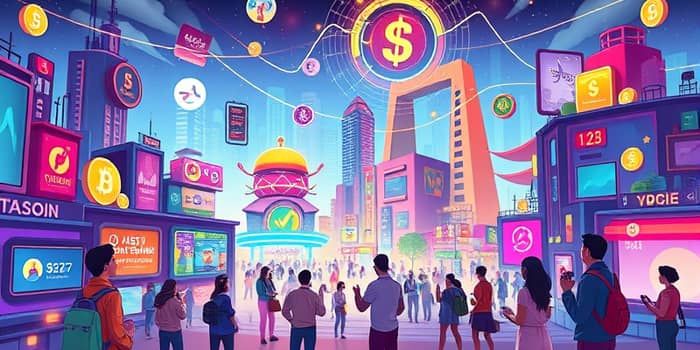
The convergence of virtual reality, blockchain, and immersive technologies is giving rise to an entirely new economic realm. As we stand at the threshold of this transformation, understanding the size, scope, and strategies of the metaverse economy becomes paramount for businesses and individuals alike.
The metaverse market is recognized as a rapidly expanding economic opportunity. In 2025, its value is estimated between USD 153.4 and 154.6 billion, with projections soaring to as much as USD 936.6 billion by 2030.
Analysts predict even more dramatic expansion beyond 2030:
Within the US alone, the metaverse is on track to grow from USD 54.7 billion in 2025 to over USD 1,017.0 billion by 2034 at a 38.4% CAGR. These figures underscore the substantial long-term growth projections driving investment and innovation.
Beyond core metaverse valuations, related technologies are catalyzing massive economic contributions. Virtual Reality (VR) added USD 13.5 billion to global output in 2022 and is projected to reach USD 138.3 billion by 2025. Concurrently, Augmented Reality (AR) and VR combined could inject USD 1.59 trillion into the global economy by 2030.
Spatial computing, a key enabler of immersive experiences, is also forecast to surge from USD 20.43 billion in 2025 to USD 85.56 billion by 2030. Meanwhile, NFT-based real estate trades surpassed USD 2 billion in 2024, marking the rise of a native economy including digitally native assets.
The metaverse economy thrives on diverse revenue streams. Businesses are leveraging four primary models to monetize virtual interactions and assets:
These models unfold across software, services, hardware, and infrastructure segments. In healthcare, remote surgeries and mental health therapies are breaking geographical barriers. Education is witnessing interactive classrooms that spark curiosity through simulation. Retailers are designing 3D storefronts with personalized avatars, while the media sector hosts virtual concerts and NFT art galleries.
Geographic factors play a crucial role in metaverse adoption and leadership. By 2035, North America is expected to capture 44.6% of metaverse revenue, driven by substantial R&D and corporate investment. Asia-Pacific follows with rapid growth fueled by its gaming powerhouse, while Europe secures a strong position led by Germany and the UK.
Meanwhile, mobile platforms will dominate with nearly 59.2% revenue share by 2035, leveraging the ubiquity of smartphones and the proliferation of 5G, projected to surpass 5.5 billion connections by 2030.
For companies, 2025 marks a business necessity rather than a futuristic concept. Leaders should:
Consumers can harness this digital evolution by:
Exploring virtual communities to network and learn new skills. Engaging in NFT marketplaces responsibly, focusing on quality assets and understanding risks. Taking advantage of immersive education platforms to accelerate personal growth.
By 2030, the metaverse is poised to integrate seamlessly into daily life, from decentralized workplaces to immersive learning hubs. This paradigm shift offers not only technological innovation but also a profound cultural transformation.
As we navigate this unfolding landscape, adopting a proactive mindset will unlock unparalleled value. Embrace experimentation, foster creativity, and build ecosystems that champion inclusivity and sustainability. Together, we can craft a future where virtual economies empower individuals and enterprises to thrive in unprecedented ways.
Now is the moment to seize the possibilities of the metaverse, forging pathways to growth and connection in a digital age without boundaries.
References