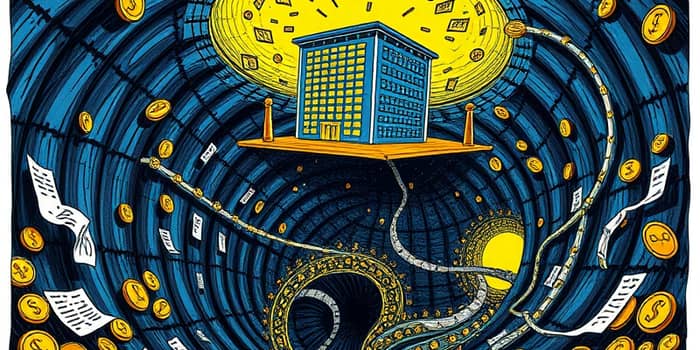
The financial world is often seen through the crystal-clear lens of regulated banks and visible markets. Yet beneath this surface lies a vast and intricate ecosystem operating largely out of sight. This network, known as shadow banking, exercises tremendous influence over credit flows, risk distribution, and economic growth.
By uncovering the mechanisms and impact of these unseen forces, investors, policymakers, and entrepreneurs can better navigate today’s complex financial landscape and harness emerging opportunities.
At its heart, the shadow banking system consists of a variety of non-bank entities that perform banking functions outside the strict regulatory framework of traditional depository institutions. According to leading authorities, these players engage in credit intermediation without formal access to central bank liquidity or deposit insurance.
Key participants include securitization vehicles, money market funds, repo markets, and fintech lending platforms. Through maturity transformation and risk distribution, shadow banks convert short-term funding into longer-term loans, creating liquidity but also introducing potential vulnerabilities.
Global shadow banking has grown explosively in recent years, driven by a confluence of factors that reshape both supply and demand for credit.
Shadow banking offers several advantages that complement the traditional financial system. By streamlining processes and focusing on specialized lending, these entities can often deliver credit more efficiently and at lower cost.
For businesses, shadow banks provide more flexible financing solutions tailored to unique risk profiles and project structures. Investors gain access to innovative instruments such as asset-backed securities and collateralized loan obligations, which can enhance portfolio returns and diversify risk.
Despite its strengths, shadow banking carries inherent risks that demand careful attention. Liquidity mismatches can arise when investors withdraw funding faster than the system can liquidate underlying assets, potentially triggering fire sales and market turmoil.
Moreover, the intricate interconnections between traditional banks and shadow entities can amplify shocks. Without robust risk management frameworks, a localized stress event may cascade across markets, undermining financial stability.
To leverage the benefits of shadow banking while mitigating its risks, stakeholders must adopt proactive approaches. Investors should implement comprehensive due diligence processes, assessing counterparty credit quality, collateral liquidity, and market depth before committing capital.
Policymakers and regulators, meanwhile, can foster financial stability by extending oversight to key shadow banking activities, promoting standardized disclosure frameworks, and coordinating cross-border supervision.
As digital technologies and evolving investor preferences continue to reshape credit markets, shadow banking is poised to expand further. This growth can support entrepreneurship, infrastructure projects, and global economic development—provided it unfolds within a framework that balances market-driven innovation with prudent oversight.
By understanding the unseen forces at play and adopting smart strategies, all participants can contribute to a more resilient and inclusive financial ecosystem. Embracing the potential of shadow banking, while safeguarding against its pitfalls, will be a defining challenge—and opportunity—for finance in the decades to come.
References