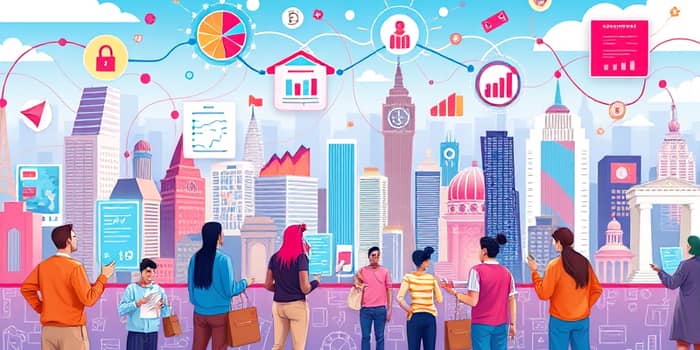
We stand on the brink of a transformative era in finance. Open banking is no longer a niche concept—it’s reshaping how individuals, businesses, and institutions engage with money. By tearing down walls around data and fostering collaboration, this new paradigm promises to democratize financial services and spark creativity across the entire ecosystem.
Global financial markets are experiencing explosive growth trajectories through 2030s. Valued at roughly $30 billion in 2024, forecasts predict the market will exceed $90 billion by 2029 and soar past $150 billion by 2033, driven by a surge in consumer demand and regulatory backing.
At its core, open banking creates a secure, permissioned data sharing ecosystem that empowers third-party providers to innovate on top of traditional banking infrastructures. Through robust APIs, banks and fintechs collaborate rather than compete, offering seamless experiences that were once unimaginable.
In the open banking universe, consumers reclaim authority over their finances. No longer confined to siloed accounts, users can aggregate information across banks, investment platforms, and payment apps in a single view.
Consumers gain unprecedented clarity, making informed decisions with confidence. This level of transparency fosters trust and encourages responsible spending habits.
Financial institutions and fintechs harness open banking to reinvent products and services. By tapping into customer-permissioned data, they can anticipate needs, personalize offers, and streamline processes.
As competition intensifies, institutions that embrace open APIs and collaborative models will stand out. This environment encourages continuous improvement and rapid iteration, ensuring services evolve alongside emerging customer expectations.
Europe currently leads with a 38% market share, underpinned by proactive regulatory frameworks fueling innovation. The PSD2 directive, for instance, mandates secure API access, catalyzing a thriving fintech ecosystem.
Meanwhile, Asia Pacific is poised for the fastest growth. From India’s UPI-linked rails to Australia’s Consumer Data Right, regional initiatives are lowering barriers and expanding access to digital finance for millions.
North America, especially the United States, is catching up rapidly. With a projected CAGR above 25%, U.S. open banking will drive billions of API calls annually, reflecting both consumer appetite and financial sector modernization.
Deployment strategies vary by institution, balancing security, control, and agility. On-premise solutions still account for a majority of implementations, favored by legacy banks seeking tight governance.
Simultaneously, cloud-native platforms are gaining traction, offering scalability and rapid development cycles. Whether through app marketplaces or unified API hubs, distribution channels are streamlining access to financial services innovations.
Behind the scenes, rigorous encryption, multi-factor authentication, and continuous monitoring ensure the ecosystem remains resilient against threats, equating open banking security to—and often exceeding—that of traditional online banking.
Several forces are propelling open banking forward. As digital transformation accelerates, consumers demand transparent, integrated solutions. Fintech investments continue to pour in, enabling startups to challenge incumbents.
Looking ahead, the fusion of IoT, blockchain, and AI promises to elevate open banking even further. Imagine automated expense management triggered by smart devices, or decentralized identity frameworks streamlining KYC and AML compliance.
Open banking heralds a future where collaboration between banks, fintechs, and consumers drives continuous innovation. By adopting an open mindset, financial institutions can deliver more personalized, efficient, and equitable services.
For businesses and individuals alike, the time to engage is now. Embrace the open banking revolution, experiment with new API-driven solutions, and put users at the heart of every development. Together, we can shape a financial ecosystem that is more transparent, responsive, and inclusive than ever before.
References