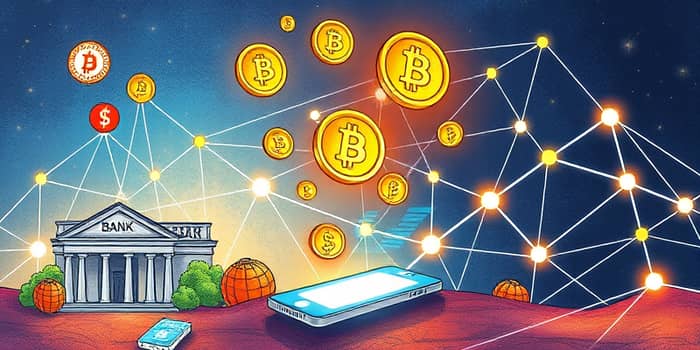
In an era of rapid financial transformation, understanding the complex world of cross-border and domestic payment systems is essential for businesses and individuals alike. From traditional messaging networks like SWIFT to emerging blockchain rails, each innovation reshapes how value flows globally.
For decades, the SWIFT network has served as a vital communication backbone for banks and financial institutions. At its core, SWIFT is a global cooperative messaging infrastructure that standardizes transaction orders and ensures accurate routing across thousands of members.
SWIFT does not move funds directly or hold accounts; rather, it translates transfer instructions into structured data blocks and transmits them via its secure SWIFTNet platform. Financial institutions rely on unique Bank Identifier Codes (BIC) to identify counterparties and maintain transaction integrity.
Within SWIFT’s ecosystem, different message types serve specific purposes. Understanding each one helps institutions choose the right channel for their needs:
With over 42 million messages transmitted daily, SWIFT remains a cornerstone of global finance. Advanced encryption, multi-factor authentication, and stringent access controls form its advanced security infrastructure, ensuring confidentiality and reliability.
By 2025, real-time settlement capabilities have triggered a real-time payment revolution reshaping commerce. Instant payments eliminate the traditional multi-day lag, offering transparent tracking and immediate fund availability for businesses and consumers.
Key regional systems illustrate this shift:
Interoperability efforts are underway, linking UPI with Singapore’s PayNow and France’s Lyra. These integrations demonstrate how instant rails can provide cost-effective, frictionless global transfers.
Beyond legacy payment rails, blockchain technology introduces a new paradigm of transparent and immutable ledgers. Distributed networks record transactions in real time, reducing counterparty risk and enabling programmable money.
Stablecoins and tokenized money are gaining traction as alternative rails. With issuance having doubled since 2024 and daily volumes approaching $30 billion, these digital assets promise swift global transfers with minimal intermediaries.
However, challenges remain. Regulatory uncertainty, fragmented technical standards, and uneven infrastructure development slow widespread adoption. As governance frameworks evolve, tokenized currencies will increasingly complement—but not entirely replace—traditional systems.
Financial institutions recognize the urgency of replacing legacy platforms. By embracing cloud-ready and agile systems and converging on ISO 20022 messaging, banks unlock new efficiencies, lower operational costs, and support instant payments.
Artificial intelligence drives further innovation, enhancing security, automation, and forecasting accuracy. Machine learning models sift through vast payment data to detect anomalies, optimize liquidity, and streamline compliance checks.
Embedded payments, integrated directly into business processes and consumer journeys, represent the next frontier. From B2C mobile checkouts to B2B supply chain settlements, embedded finance simplifies transactions and fosters stronger relationships.
As the payments ecosystem fragments and regionalizes, businesses must adopt flexible strategies. Monitoring regulatory shifts, forging partnerships, and investing in scalable technology platforms are vital steps.
Consider these strategic forces:
By leveraging these forces, organizations can customize solutions, reduce costs, and enhance customer experiences across diverse markets.
Two contrasting scenarios may define the future:
In an optimistic, multirail ecosystem, geopolitical tensions ease and global standards prevail. Financial networks interoperate seamlessly, functioning like a universal passkey for payments—from consumer commerce to complex cross-border finance.
Alternatively, a regionalization scenario could see countries prioritize self-reliance. Bilateral agreements, intermediary currencies, and localized rails might supplant global norms, creating divergent networks with unique governance models.
No matter the path, adaptability is key. Continuous learning, technology investment, and collaborative innovation will enable you to navigate uncertainty and capitalize on emerging opportunities.
Equip yourself with knowledge and a forward-looking mindset to shape the payments landscape of tomorrow. By understanding the strengths and trade-offs of SWIFT, instant rails, and blockchain, you can craft solutions that meet evolving demands and foster global connectivity.
References