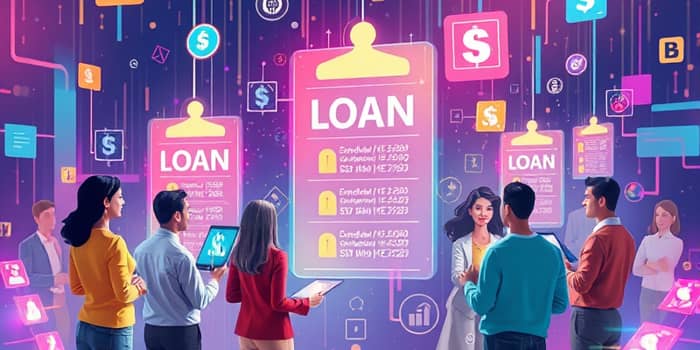
Imagine Sarah, a first-time homebuyer navigating a sea of loan options, feeling overwhelmed by generic offers that fail to address her unique situation.
Now picture a world where an AI-powered platform assesses her rent payments, job stability, and spending habits, then delivers a mortgage tailored to her needs in minutes. This is the promise of adaptive lending—a bold leap into dynamic, technology-driven approaches that tailor credit solutions for each individual.
Adaptive lending goes beyond one-size-fits-all. It’s about providing the right loan, with the right offer at the moment when borrowers are most ready to engage. In this article, we’ll explore how this approach transforms lending, driven by advanced technologies, deep consumer insights, and agile implementation strategies.
At its core, adaptive lending shifts the focus from static risk categories to personalized assessments. Traditional lending uses credit scores and fixed risk brackets, often overlooking a borrower’s full financial story.
Adaptive systems analyze multiple data streams—bank statements, transaction histories, employment records—to create a holistic profile. The result is personalized financial services with minimal friction, where each loan product adjusts dynamically to reflect an individual’s evolving financial status.
This model not only improves approval rates but also fosters trust, as borrowers feel valued and understood rather than treated as a number in a risk pool.
Several technological pillars support adaptive lending, working together to deliver precision and speed.
These technologies form an agile ecosystem, allowing lenders to introduce new products rapidly and refine existing ones based on customer feedback and performance metrics.
In an era of personalized recommendations across media and shopping, borrowers expect the same level of customization from financial services. Surveys reveal:
This expectation gap presents both a challenge and an opportunity. Lenders that harness adaptive lending can meet borrowers where they are, offering contextually relevant credit options that build loyalty and trust.
Beyond customer satisfaction, adaptive lending drives measurable financial returns and operational gains.
Institutions implementing next-best action personalization see average sales increases of 30%, while mature programs report revenue lifts of up to 25%. A strategic investment of $100 million can yield $300 million in additional revenue over time.
Operationally, lenders benefit from higher product adoption, more effective cross-selling, and reduced marketing waste through precision targeting. Automation further cuts processing costs and minimizes human error.
To realize these benefits, consider the following strategies:
By applying these tactics, lenders create memorable, value-driven experiences that encourage deeper engagement and long-term relationships.
Successful implementation demands a structured approach:
1. Data Infrastructure: Build pipelines to ingest transactional, behavioral, and alternative data sources in real time.
2. Model Development: Train predictive models that balance pricing optimization with regulatory requirements and risk management.
3. Technology Stack: Adopt an API-first, microservices architecture to support modular product updates and scalable decision engines.
4. Compliance and Control: Embed rule engines for automated KYC, AML checks, and dynamic risk-based verification.
5. Cross-Functional Collaboration: Align IT, risk, and business teams to ensure customer-centric product design and seamless integration.
Continuous testing, monitoring, and model retraining are crucial to adapt to changing market conditions and customer behaviors.
Adaptive lending introduces new risk landscapes that require vigilant oversight. Model transparency, bias detection, and explainability are paramount to satisfy regulators and maintain customer trust.
Dynamic KYC processes reduce friction for low-risk applicants while strengthening verification for higher-risk profiles, ensuring tailored compliance. Regular audits and governance frameworks help mitigate operational and reputational risks.
Ongoing risk monitoring feeds back into machine learning models, enabling continuous fine-tuning of credit parameters. This closed-loop approach ensures that emerging trends—economic downturns or shifts in borrower behavior—are swiftly addressed.
The next frontier lies in contextual credit—offering financing seamlessly within a customer’s journey. Imagine booking a vacation and receiving a personalized installment plan at checkout, powered by instant credit assessments.
Embedded lending integrates adaptive loans into digital platforms, making credit a natural extension of everyday transactions. This model deepens customer engagement and opens new revenue streams for fintech partnerships.
Partnerships between banks, retailers, and fintechs can embed credit offers directly at the point of need, such as providing auto financing options on car dealership websites or student loan extensions within education portals, creating a frictionless credit experience.
As open banking and API ecosystems mature, adaptive lending will become the norm rather than the exception. Lenders who invest in personalization capabilities will stand out by delivering timely, relevant credit solutions that foster loyalty and drive growth.
Artificial intelligence will evolve further, incorporating alternative data sources—from utility payments to social reputation metrics—expanding access to credit for underbanked communities.
Embracing adaptive lending today positions institutions to lead tomorrow’s financial services landscape with data-driven insights and customized experiences at the core of every customer interaction.
Begin your adaptive lending journey now to unlock a future where credit is fair, fast, and remarkably personal. The time to innovate is today.
References